A septic tank can be freshly pumped and a drain field can be perfectly healthy, and the house can still back up. When that happens, the problem is often the pipe in between. These lines are out of sight, and most homeowners don't think about them until one fails. The good news is that a pipe problem is usually a smaller fix than a tank or field problem, once someone finds the exact spot.
The pipes on your property
On a home with septic, two runs of pipe matter:
- The sewer line from the house to the tank. Every drain in the house empties into it.
- The effluent line from the tank to the drain field, usually ending at a distribution box that splits the flow among the field lines. Some systems use a pump and a pressure line here instead.
Homes closer to the middle of Kannapolis that are tied into city sewer still have a private line too. It runs from the house to the point where it connects to the public system. Exactly where the homeowner's part ends depends on the utility, so check with the city before assuming. If yours is a city-sewer home, ask about it when you call.
Where the clues show up
Line trouble leaves a trail that often tells a technician where to look.
Inside the house
- Toilets gurgle when the washer or tub drains
- The lowest drain backs up first, often a shower or tub
- Backups come back a few weeks after a pumping or a snake job
In the yard
- A wet strip or a soft, sunken line running from the house toward the tank
- A narrow band of grass that's greener than the rest
- Sewage smell near the cleanout pipe
On the field side
- A wet spot near the tank outlet or the distribution box, but not over the field lines
- One part of the field soaked while the rest stays dry
That last one can also be a tilted distribution box, which our septic repairs page covers.
Why lines fail around here
Roots from established trees
Lots of yards around Kannapolis have big, older trees, and roots find their way into pipe joints. They feed on the moisture, grow into a tangle and catch everything that comes down the line.
Old pipe in older homes
Kannapolis has plenty of older housing from its mill-town years. Depending on when a home was built and whether the lines were ever replaced, the pipe may be clay tile with a joint every few feet, cast iron that rusts from the inside, or Orangeburg, a tar and fiber pipe that tends to flatten and blister as it ages. Newer PVC lasts much longer, but it can still crack or pull apart.
Clay that moves
Red clay swells when it's wet and shrinks when it's dry. Over the years, that movement can shift a pipe, open a joint or create a sag where water and solids sit instead of flowing.
Weight on top
Cars, trailers and equipment parked over a line can crush it, especially where it runs shallow near the tank.
How the problem gets found
A good crew doesn't start a long trench on a hunch. The usual steps:
- Talk it through. When it started, which drains are affected, when the tank was last pumped.
- Check the tank level. If the tank is low but the house is backing up, the blockage is between the house and the tank. If the tank is overfull, the trouble is the tank or something past it, and septic pumping may come first.
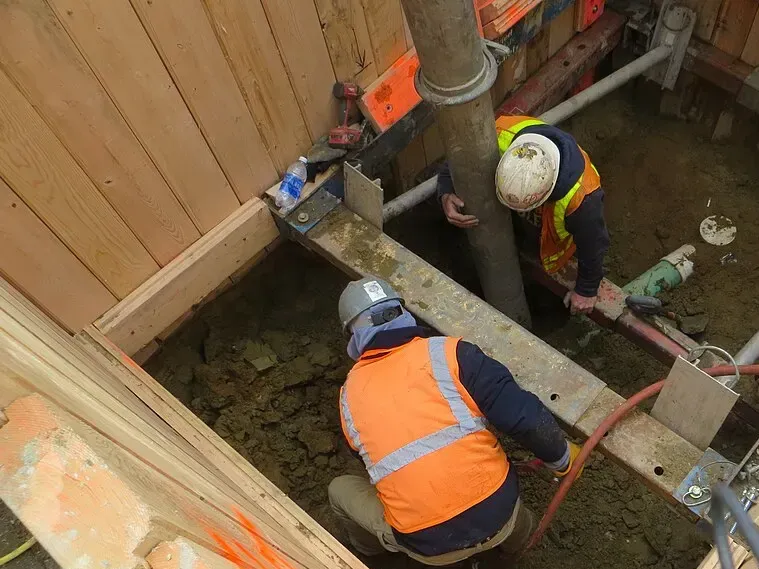
- Run a camera. A small camera on a cable goes into the line from the cleanout or the tank. Roots, cracks, sags and offset joints show up on a screen.
- Mark the spot. A locator picks up a signal from the camera head so the crew knows where and how deep to dig.
You should be able to see the footage. If someone says "the whole line is shot," ask them to show you why.
Ways to fix it
Clearing. Snaking or jetting removes a clog or roots. It's the right first step for a blockage, but on damaged pipe it's temporary, because roots come back through the same opening.
Spot repair. One bad joint or a short cracked section gets dug up and replaced with new pipe. This is the most common fix.
Replacing a run. When the camera shows old clay tile or Orangeburg end to end, or several problem spots, replacing the whole line is usually a better use of money than repeated patches.
Trenchless options. For longer city-sewer lines under driveways or landscaping, some contractors offer pipe lining or pipe bursting. Septic lines are usually short and shallow, so a regular dig is often simpler. Ask what makes sense for your yard.
Line work at the tank or out toward the field may need a permit from Cabarrus or Rowan County environmental health, depending on which side of town you're on. The contractor pulls permits when a job needs them.
What it costs
The price depends on the length and depth of the bad section, what's on top of it (lawn, driveway, landscaping), the pipe material and how much yard has to be put back. Our septic prices page explains how septic work gets priced, and you get a written quote after a free visit.
Homes in Kannapolis, Concord, China Grove and Landis can all get help. Call (980) 499-7358. If sewage is coming into the house right now, start with our backup help page.
Questions people ask
My tank was just pumped. Why is it backing up again?
If the tank isn't full, the trouble is usually upstream in the line from the house. Roots, a sag or a broken section can block flow before it ever reaches the tank. A camera inspection from the cleanout is the quickest way to know.
Is snaking the line enough?
For a simple clog, often yes. If the blockage keeps coming back, the pipe probably has a defect, like an open joint letting roots in. Clearing it again buys time, but replacing the damaged section is the lasting fix.
My house is on city sewer. Who fixes my line?
The private part of the line, from your house to the public connection, is usually the homeowner's responsibility, but the dividing point depends on the utility. Check with the city first, then have a contractor look at your section.
How long does a line repair take?
A spot repair is often done in a day. Replacing a full run takes longer, especially if it crosses a driveway or needs a permit. The contractor should include a time estimate with the written quote.